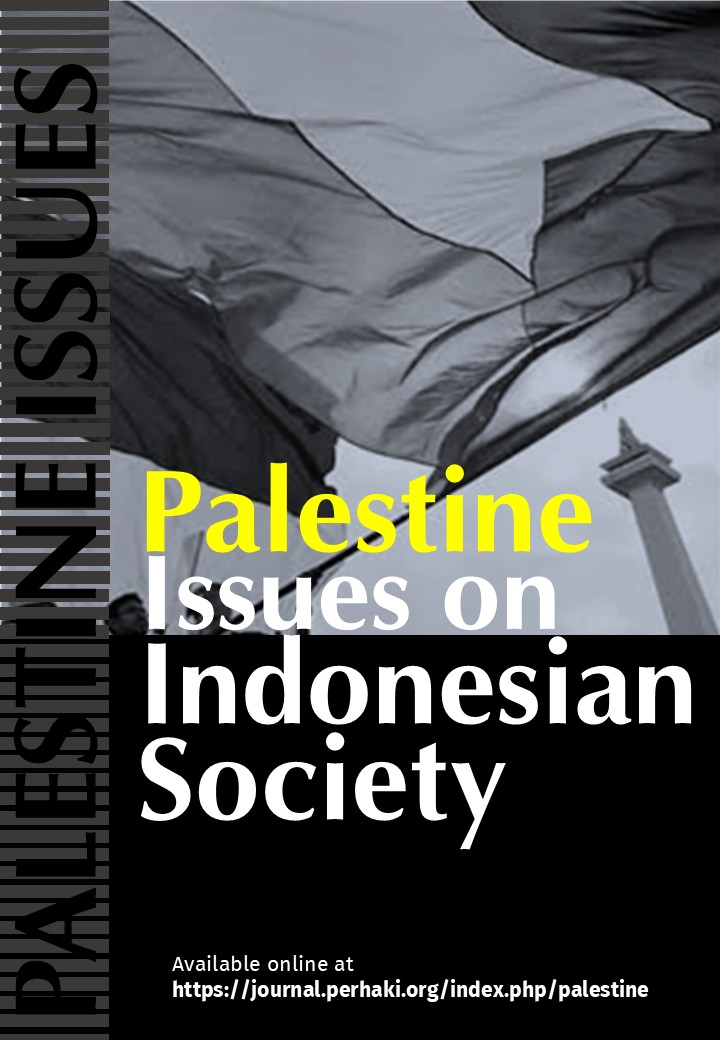
From Solidarity to Humanitarian Action: Public Fundraising for Palestine among Indonesian Muslim Communities
DOI:
https://doi.org/10.65815/mwm5my11Keywords:
Humanitarian aid, Palestine, fundraising, Muslim communities, IndonesiaAbstract
Public fundraising has become one of the most visible forms of Indonesian civil society engagement with the humanitarian situation in Palestine. Mosques, Islamic organizations, charities, universities, and informal community networks frequently mobilize financial assistance through both conventional and digital channels. This article examines the social and institutional dimensions of Indonesian fundraising for Palestine. Using qualitative socio-legal analysis, the study evaluates fundraising practices, public trust, organizational accountability, digital payment mechanisms, and humanitarian governance. The article argues that humanitarian solidarity can generate significant social capital, but large-scale fundraising also requires strong transparency and accountability mechanisms. Donors need accessible information concerning the organizations receiving funds, intended beneficiaries, distribution processes, and financial reporting. The study proposes a community-based humanitarian fundraising framework combining transparency, independent oversight, digital accountability, and needs-based allocation. Particular attention is given to the role of religious trust in encouraging donations and the risks associated with misinformation or unverified fundraising campaigns. The article concludes that strengthening accountability mechanisms can preserve public trust while improving the effectiveness of Indonesian humanitarian assistance for Palestinian communities.
References
Alhidari, Ibrahim S., Tania M. Veludo-de-Oliveira, Shumaila Y. Yousafzai, and Mirella Yani-de-Soriano. 2018. “Modeling the Effect of Multidimensional Trust on Individual Monetary Donations to Charitable Organizations.” Nonprofit and Voluntary Sector Quarterly 47 (3): 623–644. https://doi.org/10.1177/0899764017753559.
Andriansyah, Yuli. 2024. “Humanitarian Aid from the Islamic Mass Organizations in Indonesia to Palestine.” Millah: Journal of Religious Studies 23 (2): xiv–xxiv. https://doi.org/10.20885/millah.vol23.iss2.editorial.
Aryndi, Azalia Elfreda, and Amri Hana Muhammad. 2023. “Dynamics of the Emergence of Donor Trust in Online Fundraising Organizers.” Journal of Social and Industrial Psychology 12 (2). https://doi.org/10.15294/sip.v12i2.77984.
Bekkers, René. 2003. “Trust, Accreditation, and Philanthropy in the Netherlands.” Nonprofit and Voluntary Sector Quarterly 32 (4): 596–615. https://doi.org/10.1177/0899764003258102.
Dethier, Fanny, Cécile Delcourt, and Laurence Dessart. 2024. “Donor Perceptions of Nonprofit Organizations’ Transparency: Conceptualization and Operationalization.” Nonprofit and Voluntary Sector Quarterly 53 (5). https://doi.org/10.1177/08997640231211212.
Fitri, Yessi, Rini Rini, and Amilin Amilin. 2024. “Transparansi dan Akuntabilitas Organisasi Pengelola Zakat.” Jurnal Bimas Islam 17 (1). https://doi.org/10.37302/jbi.v17i1.1013.
Hamidah, Novita Nur, Frank Aligarh, Ade Setiawan, Usnan, and Faqih Hilmi. 2024. “Why Do Indonesian Muslims Donate through Crowdfunding Platforms? An Integration of UTAUT, Transparency, and Trust.” International Journal of Islamic Economics and Finance 7 (2). https://doi.org/10.18196/ijief.v7i2.22556.
Hotimah, Husnul, and Noven Suprayogi. 2023. “Meta-Analysis Study: The Effects of Accountability and Transparency on Muzaki’s Trust in Zakat Institutions in Indonesia.” Review of Islamic Economics and Finance 6 (2).
Hou, Tingting, Keke Hou, Qing Yue, and Xin Robert Luo. 2021. “Why I Give Money to Unknown People? An Investigation of Online Donation and Forwarding Intention.” Electronic Commerce Research and Applications 47: 101055. https://doi.org/10.1016/j.elerap.2021.101055.
Ikhwandha, Mohammad Fahmi, and Ataina Hudayati. 2019. “The Influence of Accountability, Transparency, Affective and Cognitive Trust toward the Interest in Paying Zakat.” Jurnal Akuntansi dan Auditing Indonesia 23 (1). https://doi.org/10.20885/jaai.vol23.iss1.art5.
Kailani, Najib, and Martin Slama. 2019. “Accelerating Islamic Charities in Indonesia: Zakat, Sedekah and the Immediacy of Social Media.” South East Asia Research 27 (4): 70–86. https://doi.org/10.1080/0967828X.2019.1691939.
Keating, Vincent Charles, and Erla Thrandardottir. 2017. “NGOs, Trust, and the Accountability Agenda.” The British Journal of Politics and International Relations 19 (1). https://doi.org/10.1177/1369148116682655.
Liang, Ting-Peng, Shelly Ping-Ju Wu, and Chih-chi Huang. 2019. “Why Funders Invest in Crowdfunding Projects: Role of Trust from the Dual-Process Perspective.” Information & Management 56 (1): 70–84. https://doi.org/10.1016/j.im.2018.07.002.
Musa, Ahmad, et al. 2021. “The Effects of Good Governance and Fraud Prevention on Performance of the Zakat Institutions in Indonesia: A Sharīʿah Forensic Accounting Perspective.” International Journal of Islamic and Middle Eastern Finance and Management 14 (4): 692–712. https://doi.org/10.1108/IMEFM-03-2019-0089.
Pitria, Ratna Kamila, Diamantin Rohadatul Aisy, and R. R. Tini Anggraeni. 2024. “Does Reporting of Aksi Cepat Tanggap Cases Affected Public Trust on Zakat Institutions?” Signifikan: Jurnal Ilmu Ekonomi 13 (1). https://doi.org/10.15408/sjie.v13i1.41075.
Rini, Rini, Ari Purwanti, and Wilda Farah. 2021. “Accountability Index for Zakat Management Institutions in Indonesia.” Journal of Management Information and Decision Sciences 24 (3): 1–10.
Salman, Kautsar Riza, and Rahimdiawati Mila Anggraini. 2022. “The Effect of Transparency and Accountability on Muzaki Loyalty through Muzaki Satisfaction as an Intervening Variable at the Amil Zakat Institution (LAZ) in Indonesia.” Journal of Finance and Islamic Banking 5 (2). https://doi.org/10.22515/jfib.v5i2.5131.
Sulaiman, et al. 2021. “Empathy or Perceived Credibility? An Empirical Study of Muslim Donating Behaviour through Online Charitable Crowdfunding in Indonesia.” International Journal of Islamic and Middle Eastern Finance and Management 15 (5): 829–846. https://doi.org/10.1108/IMEFM-09-2020-0468. (
Triantoro, Dony Arung, Tri Wahyuni, and Fitra Prasapawidya Purna. 2021. “Digital Philanthropy: The Practice of Giving among Middle to Upper-Class Muslim in Indonesia and Soft Capitalism.” Qudus International Journal of Islamic Studies.
Wahyudi, Muhamad, Nurul Huda, Sri Herianingrum, and Ririn Tri Ratnasari. 2021. “Zakat Institution of Financial Transparency Model: An Explanatory Research.” ZISWAF: Jurnal Zakat dan Wakaf 8 (2).
Wahyudi, Muhamad, Sri Herianingrum, and Ririn Tri Ratnasari. 2021. “Accountability Practices Based on Zakat Institutions Website in Indonesia.” Jurnal Riset Akuntansi dan Keuangan 9 (3): 459–466. https://doi.org/10.17509/jrak.v9i3.31225.
Yang, Cherrie. 2019. “How Can the Public Trust Charities? The Role of Performance Accountability Reporting.” Accounting & Finance. https://doi.org/10.1111/acfi.12475.
Yusra, Mahda, and Muhammad Haris Riyaldi. 2020. “Faktor-Faktor Penentu Kepercayaan Muzakki kepada Baitul Mal Aceh.” Al-Buhuts 16 (1): 1–16. https://doi.org/10.30603/ab.v16i1.1379.
Downloads
Published
Issue
Section
License

This work is licensed under a Creative Commons Attribution 4.0 International License.
All writings published in this journal are the personal views of the authors and do not represent the views of this journal or the authors’ affiliated institutions. Authors retain copyrights without any restriction under the license of Creative Commons Attribution 4.0 International (CC BY 4.0).